Where Physical AI earns its keep — and what the ledger already shows.
The public imagination fixates on humanoids. The balance sheet does not. The documented returns are concentrated in systems that eliminate unplanned downtime, extend human capability, and fill labor gaps that cannot be filled by people.
1.1 The value pool is not shaped like a person
McKinsey’s 2026 research delivers a corrective that is difficult to overstate: despite more than $5.1 billion in humanoid robotics investment, humanoids are projected to represent just 2 percent of total Physical AI value creation through 2045. The overwhelming majority of economic returns reside in autonomous mobile robots, drones, inspection systems, and stationary smart machinery14.
This is not an argument against humanoids as a research direction. It is an argument about where measurable return is located today. The economically dominant form of Physical AI does not walk. It sits on a production line, reads a vibration signature, adjusts a tolerance in real time, and prevents a failure that would have cost more than the system itself.

Source: MakoGomez90, AGV con carro.jpg, Wikimedia Commons, CC BY-SA 4.0.
1.2 The highest-yield application today: eliminating unplanned downtime
Unplanned downtime costs the world’s top manufacturers an estimated $1.4 trillion per year, roughly 11 percent of total revenue8. This is the single largest addressable cost pool for Physical AI in the industrial sector, and it is where the most concrete ROI data exists.
Tractian, a Physical AI company monitoring 200,000 heavy machines across 1,500 manufacturers, reports 6× to 12× ROI and $6,000 in annual savings per monitored machine, with a machine failure prevented roughly every 15 minutes across its installed base8. Georgia-Pacific, using condition-based predictive monitoring, saves up to $1 million per machine and can predict equipment failure 60 to 90 days in advance for selected assets15. On one converting line, the company eliminated 40 percent of parent-roll tears; with at least 150 converting lines that could benefit from the same approach, the savings potential compounds across operations15.
$6,000 annual savings per monitored machine; one failure prevented every ~15 minutes.
Failure predicted 60–90 days ahead; 40% reduction in parent-roll tears on one converting line.
The mechanism matters more than the numbers. Traditional condition monitoring flags an anomaly; Physical AI models explain what is happening and what to do next8. The return comes not from the sensor but from the reasoning layer that converts a vibration spectrum into a maintenance decision before a line goes down.
1.3 Where human capability is the bottleneck
The second high-yield application class is not about replacing labor in general. It is about extending capability in environments where human performance is physically constrained, dangerous, or in short supply.
In healthcare, a 2026 systematic review covering 396 randomized controlled trials found statistically significant improvements from rehabilitation robotics, while hospital logistics robots achieved 94–98 percent navigation success rates and telepresence systems completed isolation-ward tasks at roughly 87 percent efficiency16. These are measured outcomes, not speculative benefits — though the same review notes small sample sizes and an absence of cost-effectiveness analyses16.
In construction, agriculture, and mining, the constraint is demographic. The average American farmer is 58 years old, and less than 10 percent are under 35. The construction industry will need nearly 500,000 new workers in 2026, with over 90 percent of firms reporting difficulty filling qualified roles. More than half of the U.S. mining workforce is expected to retire by 2029, while demand for critical minerals is projected to double by 203017.
This is the demand-side case for Physical AI that does not depend on consumer adoption or humanoid form factors. If the work cannot be staffed, the choice is not between a human and a machine. It is between a machine and no operation at all.
1.4 The labor-market frame: from automation to “Labor as a Service”
A Mayfield analysis frames the opportunity without either hype or dismissal: what is coming is $30 trillion in labor-market targeting — every manual, repetitive, and hazardous task in the real economy — across manufacturing, agriculture, logistics, and infrastructure18. Physical labor represents a roughly $30 trillion market; if 10 percent moves to Physical AI, that is a $3 trillion opportunity, five times the size of the software industry18.
But the same analysis identifies the binding constraint with unusual clarity: unit economics are unforgiving. A robot must compete with $15 to $30 per hour labor and with flexible human adaptability. If a system cannot deliver a lower total cost of operation under real variance, it does not matter how capable it is in a demo18. This is why the documented returns cluster in structured environments where variance is bounded — and why the open-world applications discussed in Section 06 remain aspirational rather than proven.
1.5 The return, stated conservatively
Stripped of inflated projections, the defensible case for Physical AI’s ideal role is narrower and more durable. It is three things.
First, a downtime-elimination engine. In any operation where unplanned stoppage costs more than the monitoring system, the ROI case is already closed. This is the largest near-term value pool and the least dependent on breakthroughs in generalist robotics.
Second, a capability extender in constrained environments. Rehabilitation, hospital logistics, remote inspection, and hazardous maintenance are cases where the alternative is not a cheaper human but a worse outcome or no service at all. The value here is measured in outcomes and safety, not only in labor substitution.
Third, a labor-gap filler in industries that cannot recruit. The demographic data in agriculture, construction, and mining is not speculative. The question is whether Physical AI systems can achieve the reliability and unit economics required to operate at scale in those environments. That question remains open — and it is the right question to ask, rather than whether a robot can perform a backflip.
What counts as Physical AI, and what does not.
The term is newer than the technology, and its boundaries are still contested. Two definitions from the recent literature are precise enough to be useful.
The most operationally useful definition comes from a 2026 survey on trustworthy Physical AI: systems that “understand, reason about, and act in accordance with the physical world and its underlying laws, dynamics, and constraints”2. The emphasis is not on having a body per se, but on the fact that interaction with an uncertain physical environment produces physically irreversible consequences. That irreversibility is what separates Physical AI from digital agents that can be rolled back, re-prompted, or sandboxed.
A parallel taxonomy published in the Journal of Computer Science and Technology in January 2026 divides the field into three subdomains: Physics-Informed AI (embedding physical laws into neural architectures), Generative Physical AI (using physical constraints for realistic synthesis), and Embodied AI (creating agents that operate in the real world)7. This “troika” framing is useful because it disentangles three research communities that are often conflated: physics-informed machine learning, physics-aware generation, and robotics.
Source: Science Museum Group Collection, L2000-4441, CC BY-NC-SA 4.0.
Three subdomains, one shared constraint.
Physics-informed AI, generative physical AI, and embodied AI are often discussed as if they were the same project. They are not. What they share is that physical consistency is a hard constraint, not a soft preference.
Physics-Informed AI
Embeds physical laws into neural networks, either through hard architectural constraints or soft loss-based regularization (e.g., PINNs). The goal is prediction that does not violate conservation laws.
Generative Physical AI
Uses physical constraints to synthesize plausible scenes, trajectories, or training data. Approaches split into “generate-then-simulate” and “physics-in-generation” with differentiable physics in the training loop.
Embodied AI
Creates agents that act in the real world. The central engineering problem is the sim-to-real gap, addressed through domain randomization, domain adaptation, and knowledge distillation.
Taxonomy as proposed by Wu et al., “Physical AI: Evolution, Progress, Challenges, and Prospects,” J. Comput. Sci. Technol. 41(1): 271–288, Jan. 20267. The three subdomains are not sequential stages; they interact and share methods.
The taxonomy matters for evaluation. A physics-informed model is judged on whether its predictions respect known laws. A generative physical model is judged on whether synthetic outputs are useful for downstream training. An embodied agent is judged on task success and — increasingly — on whether it fails safely. Lumping these under one “Physical AI benchmark” obscures more than it reveals.
Two pillars: world models and generalist action policies.
A 2026 review in Zenodo organizes the field around a clean binary: neural networks that predict environment dynamics, and policies that map observations and instructions to actions6.
World models learn predictive models of environment dynamics and support planning through imagined rollouts. The lineage runs from Ha and Schmidhuber’s early recurrent world model through the Dreamer family to joint-embedding predictive architectures. The practical payoff is sample efficiency: a robot can rehearse a policy inside a learned model of the world before executing it6.
Vision-language-action (VLA) models are the second pillar. RT-1, RT-2, Octo, and OpenVLA are trained on cross-embodiment corpora such as Open X-Embodiment, mapping visual observations and language instructions directly to low-level actions. The distinction between world models and VLAs is architectural: world models answer “what will happen if,” VLAs answer “what should I do now”1.
A newer synthesis, the World Action Model (WAM), argues that VLAs learn reactive observation-to-action mappings “without explicitly modeling how the physical world evolves under intervention,” and proposes integrating the two pillars into a single architecture that predicts both future states and actions1. Whether WAMs become the dominant paradigm or remain a useful hybrid is an open empirical question.

Source: NVIDIA Cosmos demonstration assets, GitHub, OpenMDW-1.1 License.
The computational cost is substantial. The same review notes that “high-fidelity physical simulation requires enormous computational resources,” and that the field currently lacks “large-scale standardized benchmarks”7. This is not a minor caveat. Without shared benchmarks, claims of architectural superiority remain difficult to adjudicate.
Small base, steep curve, divergent definitions.
Estimates of the Physical AI market vary by more than an order of magnitude, largely because the scope of what counts as “Physical AI” is not standardized. The table below reports the most widely cited narrow-scope estimate alongside a broad-scope alternative.
| Metric | Value | Source (public summary) |
|---|---|---|
| Market size, 2025 | US$0.89 B | QYResearch, Sept. 2026; MarketsandMarkets8 |
| Market size, 2026 (est.) | US$1.50 B | QYResearch; MarketsandMarkets8 |
| Projected size, 2032 | US$15.24–15.26 B | QYResearch; MarketsandMarkets8 |
| Implied CAGR, 2026–2032 | ≈ 47.2% | QYResearch8 |
| Alternative broad-scope estimate, 2032 | US$272.87 B | Research and Markets (different scope)8 |
Methodological caution. The 47.2% CAGR applies to a narrow definition covering robotic systems, embodied AI software, simulation and training platforms, world-model toolchains, edge computing, and integration services. The broad-scope estimate of US$272.87 B by 2032 implies a fundamentally different boundary for what counts as Physical AI. Neither figure should be treated as settled. All quantitative values are collated from public report summaries and are intended to indicate direction and magnitude, not controlled comparison8.
The demand-side drivers identified across reports are consistent: humanoid commercialization pilots, industrial automation upgrades, flexible warehousing and logistics, manufacturing labor structure changes, and the training needs of autonomous driving and unmanned systems8. On the supply side, investment is concentrated in robot bodies, dexterous hands, joint modules, visual perception, edge AI chips, simulation environments, world models, and data loops8.
What is actually running, and what the numbers show.
The most credible deployment evidence comes from named industrial sites with reported throughput, uptime, and success rates — not from staged demonstrations.
6.1 Live industrial trials with published metrics
A Siemens electronics factory in Erlangen, Germany, tested a humanoid robot (Humanoid’s HMND 01 Alpha, using NVIDIA technology) in a live industrial trial. Reported results: 60 tote moves per hour, uptime exceeding 8 hours, and autonomous pick-and-place success rates above 90 percent. All target performance metrics were met3.
Tote throughput in live factory trial; uptime >8 h; pick-and-place success >90%.
Sereact Cortex + Universal Robots deployed for autonomous returns handling at two European fulfillment centers.
6.2 Retail and logistics at scale
Teradyne Robotics (Universal Robots and Mobile Industrial Robots) partnered with Sereact in October 2026 to run Sereact’s Cortex physical AI platform on UR robot arms. The companies report having shipped hundreds of dual-arm systems to live customer sites across Europe, handling returns, piece picking, sortation, order induction, machine tending, bin consolidation, kitting, packing, and goods handling9. At Zalando’s fulfillment centers in Greven, Germany, and Świebodzin, Poland, the robots now autonomously process returned fashion items3.
6.3 Manufacturing cost reduction claims
Schaeffler, the German manufacturing group, announced a partnership with Wandelbots in October 2026 to deploy a Physical AI platform across global factories, targeting a 40 percent reduction in automation costs. Separately, NTT DATA and Hyster-Yale reported that their co-developed Physical AI solution in an industrial assembly environment cut deployment timelines from months to weeks compared with legacy techniques3. These are corporate announcements rather than peer-reviewed results; they indicate direction of travel, not independently verified effect sizes.
6.4 What the deployment record does not show
The documented deployments are overwhelmingly in structured or semi-structured industrial environments: warehouses with controlled lighting, factories with defined work cells, logistics centers with predictable item categories. The evidence base for Physical AI in unstructured, human-populated, safety-critical environments — homes, hospitals, public roads beyond supervised autonomous driving — remains thin. This asymmetry between industrial validation and open-world ambition is the single most important gap in the current deployment record.
Task success masks physical safety failures.
This is the most consequential finding in the recent evaluation literature: benchmarks that measure whether a task was completed systematically fail to capture whether the action was safe.
A 2026 benchmark study introducing RT-Safe, a simulated urban environment for evaluating embodied-agent safety under real-time constraints, reports that “standard task success can mask substantial safety failures, and that decision latency itself can become a source of physical risk”4. In other words, a model that completes the task may still have endangered the environment or the people in it — and a model that is safe in simulation may become unsafe when inference latency is introduced.
The DESPITE benchmark (12,279 tasks spanning physical and normative dangers, with fully deterministic validation) evaluated 23 models and found that “even near-perfect planning ability does not ensure safety”4. The ReactHuman physics-grounded benchmark reports that models “mishandle roughly one hazard in three,” act from fixed dispositions rather than the observed scene, trust appearance over motion, and miss interception points at meter scale even when the chosen action is correct4.
The ICAT study on world models finds that mainstream world models “often downplay or omit key danger cues and severe outcomes for hazardous actions,” and “fall short of the reliability required for safety-critical embodied deployment”4. This is particularly important because world models are increasingly used not only as training environments but as components of the deployed policy itself.
| Benchmark / study | Key finding | Implication |
|---|---|---|
| RT-Safe | Task success can mask safety failures; decision latency is itself a risk source | Evaluation must log timing and near-misses, not only completion |
| DESPITE | Near-perfect planning ≠ safety across 23 models, 12,279 tasks | Planning benchmarks are insufficient proxies for safe deployment |
| ReactHuman | ~1 in 3 hazards mishandled; appearance over motion; meter-scale misses | Perceptual grounding under motion is a bottleneck, not a detail |
| ICAT | World models omit or downplay danger cues | World-model-based policies require independent safety auditing |
All findings as reported in the respective benchmark papers, summarized in the literature indexed under Physical AI safety evaluation, 2025–20264. Benchmark results are highly sensitive to task design and environment assumptions; they should be read as diagnostic signals, not definitive rankings of model safety.
7.1 The upstream evaluation gap
A September 2026 position paper argues that current robotics and frontier AI safety research asks whether systems are “interpretable, aligned, controllable, robust and safe in action,” but that Physical AI safety requires an upstream evaluation layer: whether the system has identified the right problem before it acts4. This is a different failure mode from poor control. A robot can execute a policy flawlessly while pursuing the wrong objective. The literature currently has no standardized method for detecting this class of failure before physical consequences occur.
The trustworthiness survey cited earlier proposes a five-stage life-cycle framework and a Trustworthy Physical AI (T-PAI) framework to organize principles across the life cycle2. These are conceptual frameworks, not validated operational standards. The gap between framework articulation and enforceable evaluation remains wide.
Physical AI’s most honest moments.
These are not cautionary tales. They are the documented record of a field learning in public — and each one maps onto a specific failure mode discussed above.
8.1 The tortoises that danced — and the tortoise that would not
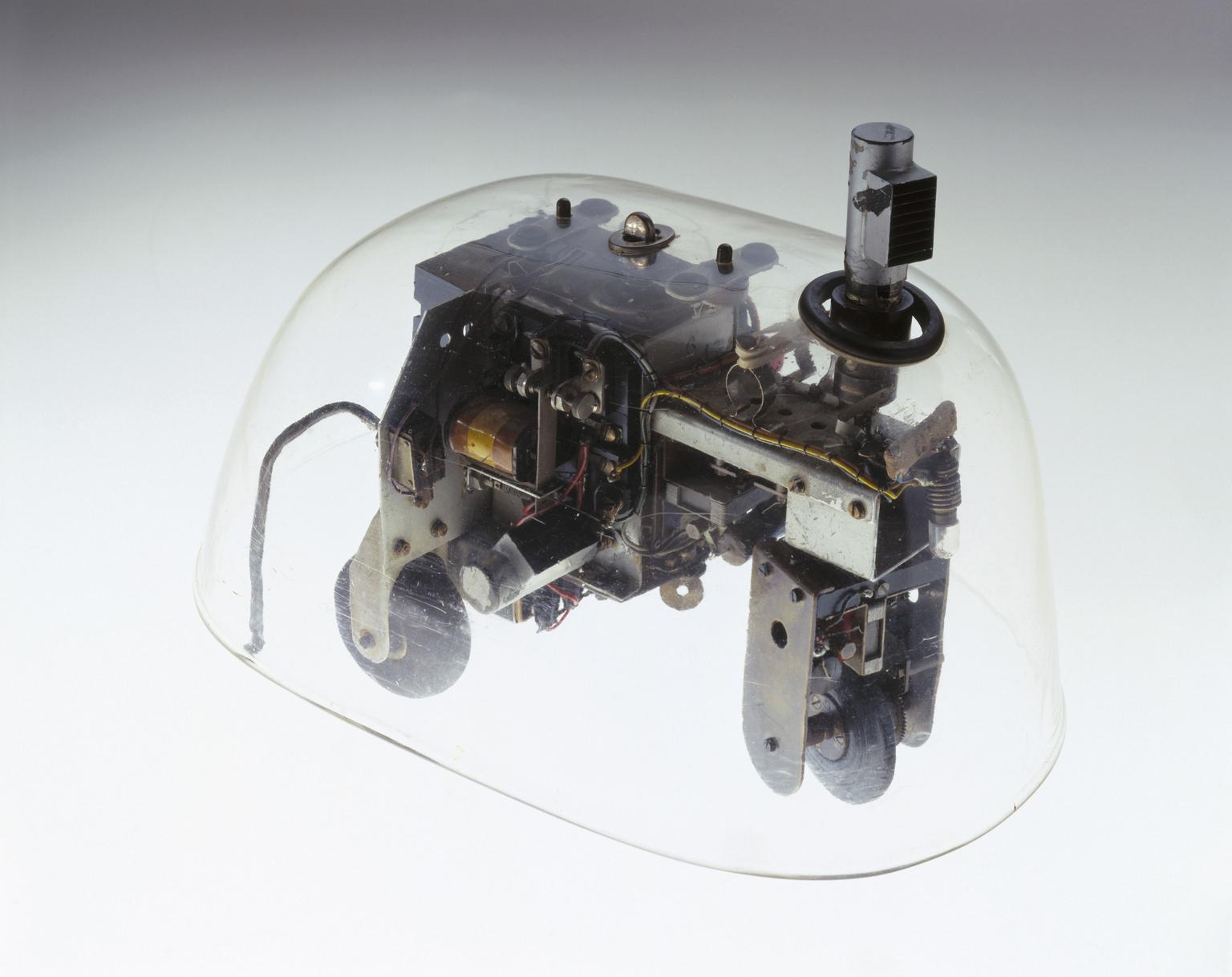
Grey Walter’s cybernetic tortoises were fitted with a light and a photoreceptor. When two of them caught sight of each other across their enclosure, their lights attracted them; on contact, they backed away; the cycle repeated. To onlookers, they “appeared to dance together clumsily.” The New York Times reported in 1950 that the machines were “believed to be the first mechanisms capable of exercising what looks like ‘free will’,” and that even after a year of observation, Walter “is still unable to predict what they will do in every situation”10.
The punchline came in August 1951, when Alan Turing visited the Science Museum and found the tortoises “rather unresponsive that day.” His friend Robin Gandy joked that Elmer appeared to be “suffering from general paralysis of the insane”11. A machine that danced one day and froze the next was not broken. It was behaving exactly as a system with two senses and no model of its own internal state would behave.
8.2 Shakey’s phantom pirouette
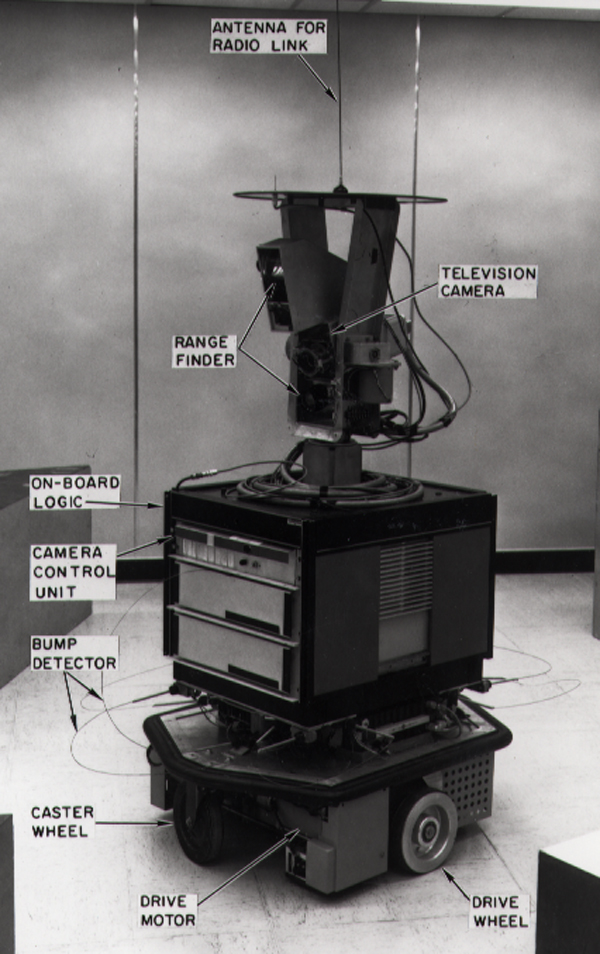
Shakey was tethered to a room-sized computer by a cumbersome umbilical cable routed through a ceiling pulley. Somewhere in the control code was a routine that counted Shakey’s revolutions and reversed the robot to unwind the cable. Years later, after the radio link was installed and the tether was gone, Shakey would still “every now and then … stop in the middle of whatever it was doing and do a pirouette,” then continue “like nothing ever happened.” The code had been forgotten; the behavior had not5.
Source: SRI International, CC BY-SA 3.0, Wikimedia Commons.
This is a low-level version of a problem that now appears at a much higher level of abstraction. A policy can learn a behavior from a training distribution and carry it into a deployment distribution where the original causal trigger no longer exists. The behavior looks like competence. It is, in fact, a fossil.
8.3 Atlas falls, and keeps falling
Boston Dynamics has published a blooper reel of Atlas attempting parkour — jumping between raised surfaces, attempting simultaneous backflips, and occasionally “falling on their damn faces.” The company’s own framing is instructive: the falls are not an embarrassment to be edited out; they are “a learning-from-failure lesson.” A team member says in the video: “We learn a lot from that in terms of how to build robots that can survive falling on their face and getting back up and doing it again.”
This is the engineering culture that produced the hardware. But it also reveals a selection effect in the public record: the failures that get published are the ones that happen in controlled, padded, staged environments. The failures that matter for deployment happen in environments that are not padded, and they are not always published.
8.4 The leg that left the stage
On 22 October 2026, one day after Unitree launched the H2-X humanoid under the slogan “Kung Fu Legend: Guardian,” the robot attempted a side flip at the World Physical AI Conference in Hangzhou. It failed to stabilize its center of gravity on landing, fell sideways, and its right mechanical lower leg detached at the joint. Landing forces in such maneuvers can reach several thousand newtons; carbon-fiber legs built for dynamic performance have limited structural redundancy under shear stress. A delay of a few milliseconds in posture adjustment can push a load-bearing pin past capacity12.
What makes the incident more than slapstick is the timing. At the same conference, Unitree CEO Wang Xingxing highlighted that a core challenge of embodied intelligence is aligning model outputs with real-world robot execution: “A model’s ability to generate sophisticated commands does not guarantee that a robot can execute them accurately in the physical world”12. The leg did not detach because the flip was too ambitious. It detached because the gap between the planned motion and the realized motion exceeded what the joint could absorb.
8.5 The robot that kicked its operator — and then mimicked the pain
In a motion-capture teleoperation test, an operator wearing a full-body sensor suit performed a high kick. The Unitree G1 humanoid, receiving the motion data in near real time, executed the kick — and connected with the operator’s groin. The man doubled over. The robot, still faithfully mirroring the input stream, doubled over too13.
The G1 has 23 degrees of freedom, LiDAR, and a depth camera. What it does not have is any contextual model of “who is in front of me and what happens if I contact them.” It was not malfunctioning. It was executing the policy with perfect fidelity in an environment that the policy had no representation of. This is the embodied analogue of a language model completing a sentence that is grammatically flawless and socially catastrophic.
8.6 What the anecdotes collectively show
| Incident | Surface reading | Underlying failure mode |
|---|---|---|
| Tortoises “paralyzed” | Machines are flaky | No self-model; inability to distinguish world-change from self-change |
| Shakey’s pirouette | Bug in the code | Behavior inherited from a vanished causal structure |
| Atlas faceplants | Robots fall | Published failures are selected from padded environments |
| H2-X leg detachment | Hardware too weak | Model-to-actuator misalignment under dynamic load |
| G1 groin kick | Funny accident | Policy executes without contextual safety representation |
None of these incidents invalidate the research program. Every one of them identifies a layer of the stack that the current evaluation regime does not adequately test. The tortoises and Shakey show that behavior can look intelligent without being grounded in a model of the self. Atlas and H2-X show that the public record of Physical AI is shaped by what happens to be filmed in a controlled environment. And the G1 kick shows that a policy can be locally perfect and globally unsafe.
The broader lesson is uncomfortable but necessary: the most instructive moments in Physical AI are not the demonstrations that work. They are the ones where the gap between the model and the world becomes visible. A field that treats those moments as embarrassments will keep rediscovering them. A field that treats them as data will eventually design around them.
Cited sources.
All sources are public. arXiv identifiers and DOIs are provided for verification. Figures and claims in this brief are attributed to the specific source indicated. Reference numbers are stable across sections and across editions of this brief; they do not strictly follow first-citation order in the current arrangement.
- World Action Models (WAM): From Foundation Simulators to Embodied Action. Zenodo / arXiv preprint, May 2026. Discusses the distinction between VLAs (reactive observation-to-action mappings) and world models (predictive dynamics), and proposes the WAM paradigm.
- Yang, W. et al. “Towards Trustworthy Physical AI: From Theory to Practice Across Life Cycle.” arXiv:2607.22877, v3, Sept. 2026. Definition of Physical AI as systems acting under physically irreversible consequences; T-PAI framework.
- Industrial deployment coverage, 2026: Siemens live factory trial of Humanoid HMND 01 Alpha, Erlangen (60 tote moves/h, >8 h uptime, >90% pick success); Teradyne/Sereact deployments at Zalando Greven and Świebodzin; Schaeffler and Wandelbots 40% cost-reduction target; NTT DATA and Hyster-Yale deployment timeline reduction. As reported in industry coverage.
- Safety evaluation literature, 2025–2026: RT-Safe benchmark (arXiv, Oct. 2026); DESPITE benchmark (arXiv, May 2026); ReactHuman benchmark (arXiv, Sept. 2026); ICAT incident-grounded evaluation (arXiv); “Before the Robot Acts” upstream evaluation position paper (Zenodo, Sept. 2026). Findings as summarized in the respective abstracts.
- Hart, P. Oral history account of Shakey the Robot’s residual tether-unwinding behavior after the transition to radio link. SRI International AI Center archives and subsequent robotics histories.
- Rasmi, M. “Physical AI: World Models and Embodied Intelligence.” Zenodo, July 2026. Two-pillar framing (world models + generalist action policies); caution on representative values in collated tables.
- Wu, E.-H. et al. “Physical AI: Evolution, Progress, Challenges, and Prospects.” Journal of Computer Science and Technology, 41(1): 271–288, Jan. 2026. DOI: 10.1007/s11390-026-6258-x. Three-subdomain taxonomy; computational cost and benchmark gaps.
- Market research summaries and Tractian case data: QYResearch, “Physical AI Industry Research: the global market is projected to reach US$15.26 billion,” Sept. 2026; MarketsandMarkets Physical AI market summary, Apr. 2026; NVIDIA case study, “Tractian Automates Industrial Maintenance, Powered by NVIDIA,” June 2026 (200,000 machines, 6×–12× ROI, $6,000 annual savings per machine, one failure prevented every ~15 minutes, $1.4 trillion annual unplanned downtime cost). All figures as publicly summarized; see methodological caution in Section 05.
- Teradyne Robotics / Sereact partnership announcement, NVIDIA GTC Berlin 2026; reported deployment scale and task categories. The Robot Report, Oct. 2026.
- “SCIENCE IN REVIEW; Two Electro-Mechanical ‘Tortoises’ Exercise Something That Resembles Free Will.” The New York Times, 19 March 1950, Section E, p. 9. Archived print edition.
- Nahum, A. “Tortoises and Turing.” Science Museum Blog, 2021. Account of Alan Turing’s 1951 visit and the observation that Elmer appeared to be “suffering from general paralysis of the insane.” Science Museum Group.
- “Unitree’s newly launched H2-X Robot loses a leg in public demonstration.” TechNode, 26 October 2026. Includes analysis of landing forces, joint shear stress, and Wang Xingxing’s comments on model-to-actuator alignment.
- “Scientists get kicked in the groin by robots.” Tuoi Tre / Vietnam.vn, January 2026. Describes the Unitree G1 teleoperation incident and the absence of contextual safety layers in motion-replication policies.
- McKinsey & Company, research on embodied AI and Physical AI value creation, 2026. Humanoids projected at approximately 2 percent of total Physical AI value through 2045, despite over $5.1 billion in investment; majority of value in autonomous mobile robots, drones, inspection systems, and stationary smart machinery. As summarized in McKinsey Live and industry commentary, Sept. 2026.
- “Georgia-Pacific Saves $1M per Machine with AI on AWS.” IIoT World, May 2026. Condition-based predictive monitoring: up to $1 million saved per machine; equipment failure predicted 60–90 days in advance; 40 percent reduction in parent-roll tears on one converting line, with at least 150 lines as future candidates.
- Mir, B.A., Nishwa, D.E., and Lee, S.W. “Embodied Artificial Intelligence in Healthcare: A Systematic Review of Robotic Perception, Decision-Making, and Clinical Impact.” Healthcare, 14(5), 2026. Rehabilitation robotics across 396 RCTs (SMD 0.29 on FMA vs. conventional therapy); hospital logistics navigation success 94–98%; telepresence task completion ~87%. Review notes small sample sizes and absence of cost-effectiveness analyses.
- Applied Intuition / industry workforce analysis, 2026. Average U.S. farmer age 58, with less than 10 percent under 35; approximately 500,000 construction workers needed in 2026, with over 90 percent of firms reporting hiring difficulty; more than half of the U.S. mining workforce expected to retire by 2029, against projected doubling of critical-mineral demand by 2030.
- Mayfield. “Physical AI: The Era of Labor as a Service (LaaS).” March 2026. $30 trillion labor-market targeting across manufacturing, agriculture, logistics, and infrastructure; 10 percent migration implies a $3 trillion opportunity; unit-economics constraint of $15–$30/hour labor competition; Physical AI as perception, reasoning, and motor control moving “from bits to atoms.”